Friday, 28 July 2017

Aadhar IN… Privacy OUT.. Is Privacy a Fundamental Right?

Background:

Ever since the GOI tried to link Aadhar with Pan Card and Bank Accounts, debates on privacy have become a norm at various forums.

-          Can the government condition the receipt of public benefit on waiver of Fundamental rightand do we waive the right of privacy for a greater benefit?
-          Is the right to privacy absolute and can a government, which cannot give right to privacy uphold the principles of democracy
-          Is Privacy just a human right or aFundamental right guaranteed by the Constitution of India?
-          Do the scan and fingerprints of Aadhar violate citizen’s privacy?
-          Is the right to privacy absolute or can the Government  even snoop into my bathroom?

The techies (from data protection angle), the activists (human rights angle), lawyers (fundamental right angle), the politicians (based on their party position), the economists (empowerment & governance angle) – each one of them debate from their angle. A nine-judge bench is revisiting the question of privacy 55 years after the Supreme Court decided that it was not a basic fundamental right for citizens. Amidst all these active debates, let us explore the concept of privacy in finer details.

What is Privacy?

 The essence of privacy is reflected in ancient Hindu culture. Aspects of privacy of thought, respect to bodily integrity, physical space/property, information and communication and identity did find a place in Hindu scriptures such as Manusmriti, Yanawalkya Samhita &Chanakya’sArthashastra. Further, the references to privacy exist in the Bible, Hebrew, Greek and ancient Chinnese cultures. These perceptions focused on right to solitude.

In the modern context, privacyis seen as a way of drawing the line as to how far society can intrude into a person’s affairs – aspects of personal body, information, communication and territory. Privacy is a Human right recognized in the U.N. Declaration of Human rights.

Various definitions arose in the modern context regarding privacy –
-          “Privacy is a right to be left alone”
-          “Privacy is a value which underpins human dignity, freedom of association and speech”
-          “Privacy is a three-part product – Secrecy, Anonymity and Solitude”

Right to Privacy:

“Even the crown cannot enter the poorest man’s cottage, inspite of its being ruined by storm, wind or rain” (Parliamentarian William Pitt, U.K)

Any personal information has to be obtained fairly and lawfully, used only for the original specified purpose, adequate and not excessive, tothe purpose, accurate and up to date.

Many countries have recognized the UN Declaration but in many other countries like the USA, Ireland and India, the courts have found that right as a derivative from other fundamental rights.

Right to privacy is not explicitly stated in the Americanconstitution, but right to privacy is protected by specific statutory laws and also by several amendments assigning a“Derivative Fundamental Right” status to privacy.

The Constitution of India also does not specifically guarantee “Right to Privacy”; but various judgments over the years have given limited rights to privacy through Aritcle 21 - The Right to Life and Liberty. Reasonable restrictions can be imposed on the right to privacy by the State subject to Article 19(2) of the Constitution of India.

Threats to Privacy To-day:

Globalization, Convergence of data, and Multimedia have dismantled the barriers. Technology has thrown up identity systems, and surveillance of communications, andwork place which were adopted by Smart cities, Smart airports and Smart offices, contributing significantly toinvasion of privacy.
In India, many opted for Aadhar voluntarily, but amendments to Finance Bill, 2017 expand the scope of Aadhar beyond welfare services to PAN, Bank accounts etc., making it almost mandatory.

Arguments for and against:

For Aadhar:

-    It is a governance cum empowerment cum surveillance tool, not just an effective welfare administration tool.
-          It enables a clean responsible behavior of citizens, as all information is wired. (The precise reason why USA is able to reach its citizens effectively)
-          Black money prevention, eliminates multiple PAN used by same individuals, better tax collection and better KYC for all stakeholders are all facilitated by Aadhar backed identity.
-            Making it voluntary will create exclusions from the Aadhar Data base. Even a small gap can be used by Tax evaders who may start re-energizing cash economy again. The cash outside the system can get strengthened which is turn will circulate into cash based assets building.A jobless paper growth will emerge as in the past. Hence Aadhar backed transactions makes the whole eco-system cleaner.
-          Aadhar enabled economy facilitates cleaner governance and therefore it is a pre-requisite, as we march towards a developed nation status.

Against Aadhar:

-          Aadhar being mandatory, different data bases are getting linked by common ID, exposing personal information to hackers and government surveillance. (Mitigation strategy: Better Data protection & Security system & Law)
-          The lack of privacy and pervasive surveillance environment has a negative impact as the society (These people who argue this way have unhesitatingly grown all their private data for USA visa. Why not for our own country? Also consensus on protective measures can evolve. Debates should focuson ‘How to protect data, once we give them? than ‘Do we get into Aadhar systems?’
-          There is no provision to opt out of Aadhar. (The system of exclusions permits leakages in the overall system, hence no exclusions)
-          The lack of proper informed consent for allowing Aadhar data with law enforcement bodies. (Aadhar act can bring safety measures for protection, once it evolves)
-          The capability of government’s bureaucracy to handle the huge Aadhar database is a question mark. (India gives IT experts to outside world and therefore has the  ability to develop this strong IT architecture)
-          Aadhar act was passed through money bill in the Lok Sabha avoiding Rajya Sabha voting thereby no open debate took place before adoption (This is a matter of political majority. The same can also be debated and passed in Rajya Sabha once the ruling party has the required majority in Rajya Sabha as well later. That will delay the benefits of Aadhar outlined earlier)
-          India’s Aadharcannot be compared to the American social security number.  US security number does not call for bio-metrics, is not an identification number, it does not link data bases, it has adequate privacy safeguards, and its use is getting restricted as against the expanding use of Aadhar (Social security number enables credit rating and the private sector uses this security number extensively in USA. We cannot replicate the American system in India.   American citizens are taxed on global income unlike their Indian counterparts.  There are enough tracking mechanisms in USA – Communication tracking, Drill down of data of US citizens from commercial data bases, limited cash economy enabling adequate financial transaction tracking, finger prints of people with FBI, Department of Homeland Security and Department of State consular services (VISAS) monitormore than 75% of the USA population, - all these give enough tracking options for USA government. India, with an intent to march towards a developed nation status needs to have these tracking done, hence expanding use of Aadhar is justified)

Where do we go from here?

There was a time when regular and honest tax paying Indian citizen had to accept the uneven wealth growth in the hands of unscrupulous tax evaders and bribe seekers, and we reconciled to the fact that sinless wealth is an optical illusion. Bottom line growth only was considered as business ethics. We started accepting being cutthroat as smartness. In this environment, comes a ray of hope,and a march towards clean governance.Today I register my take on Aadhar card in this public domain;
-          As a honest tax paying and patriotic citizen of India,
-          As an ardent fan of dharmic governance where the two horses viz, the capitalism driven wealth generation and the socialism driven wealth distribution are monitored by the reins of dharmic accountability and control,
-          As a follower of compassionate capitalism, the sustainable wealth generation happens with fairness to all stakeholders,
 would like to unhesitatingly declare that I would rathersacrifice my privacy instead of sacrificing the goal of fast tracking India to a developed nation status.
Judiciaries may debate, activists may raise human rights issues, but I call for waiving the right of privacy for agreater national cause and a greater vision.
If flying in aeroplane is risky, we cannot banaeroplanes. This century comes with certain risks. We need to build ample safeguards for data protection and privacy and not call for abandonment or dilution of Aadhar.
The ultimate resolution of this present controversy has to recognize.
-          the need for Aadhar to provide efficient and honest governance to its citizens and
-          the stringent safeguards to protect the data and preserve the privacy.

In short, “privacy”has to open the door when “public interest” knocks the door.
Are you hearing……?

Tuesday, 24 January 2017

Who is Rudra? - Part 3


The Macedonians and Greeks came with Alexander the Great to the Hindu Kush range. They were mesmerized by the land of the gods, snow-covered, forested mountains higher than Olympus. The sun rising and setting among the glistening peaks painted a breathtaking picture. They were enchanter by the stories of the magical kingdoms of the air; of the heavens; of Vishnu and Shiva; of cities in the sky inhabited by sky demons. They were fascinated by the story of Surya, the sun god, who galloped across the sky each day in his golden chariot, pulled by the seven horses, while down below in the dark bowels of the earth were giant serpents, red-eyed, flesh-eating demons and other creatures of the underworld.

It was at this time that the people of Bharat were looking inwards, while the Macedonians aggressively explored outwards and wanted to conquer the world. The kingdoms of Bharat were threatened by the aggressive Macedonians. No king or kingdom was free from the aggressor’s attack. Fragmented kingdoms, disunity and distrust among the rulers made these kingdoms an easy target for the Macedonians.

During this period, several events are shrouded in mystery—what brought Alexander to India? How did he die at such a young age? What were the origins of Chandragupta Maurya? How did a young lad of humble origins take on a mighty king? How did a poor Brahmin pundit help a poor young man rise to power from nowhere? What extraordinary powers did Chandragupta possess that made him so successful? Who were his key generals? Who won wars for him? The questions are endless.

There are several seemingly unconnected dots, as the history of this time is shrouded in deep mystery. ‘Rudra’ effortlessly unlocks the ancient secrets and aligns the unconnected dots. Mystery unraveled; secrets decoded…

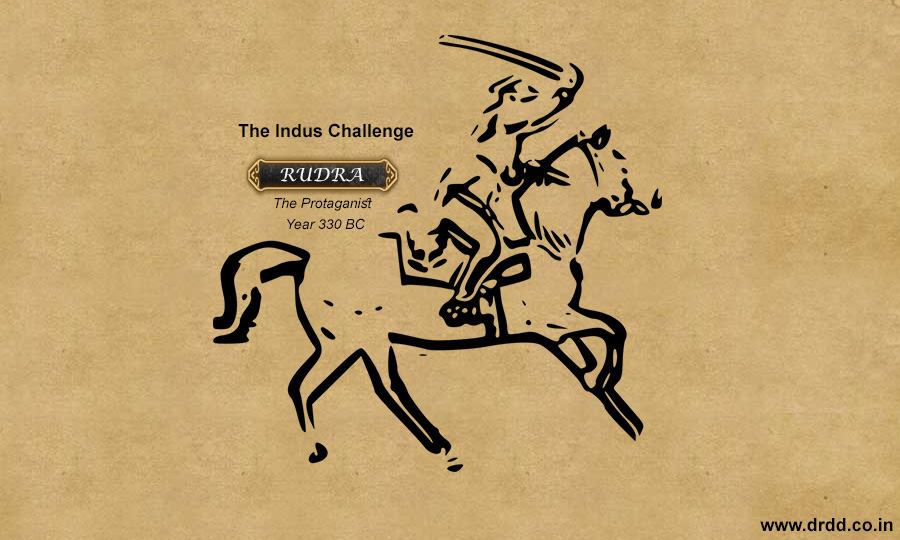
In the second avatar (Janam Two) as ‘Rudra’ during the tumultuous times of Alexander and Chanakya, he offers stunning clues and revelations. His decrypting skills leave a trail that answers several mysteries in our rich history.

At last, Rudra, heading the Nine Unknown Men Army (NUM), has arrived to decode the secrets to save humanity from cataclysm and extinction.

How Rudra could do all these? To know grab your copy of ‘The Indus Challenge’ available on all leading book stores and Ecommerce sites. http://bit.ly/2hykzFm.

Thursday, 5 January 2017

Who is Rudra? - Part 2

http://drdurgadoss.blogspot.in/2016/12/who-is-rudra-part-1.html#.WG44GdJ97IU

3000 BC...

For Illustrative Purpose Only
The heroes who saved the planet from cyber terrorists could not avoid succumbing to this physical terrorism. Why? Why? This is what Shiv’s (NASA Scientist) unconscious mind questioned.

His mind was filled with the chorus of a great army crying out the name, “Sagar, Sagar, Sagar….” He was lying on the battlefield, a wounded solider covered with deep cuts. It was a bloodbath all around.

He was holding back his last breath, waiting for his beloved wife and newly born son. It was the battle between the Kauravas and Pandavas, in the land situated between the two rivers, the Sarasvati and Drishadvati, the land where Manu wrote his Manu-smriti and the land where the Rig and Sama Vedas were compiled.

His calm mind resisted the image. “This battleground is not the land of my birth or my beloved kingdom. This is not the place where I spent my joyful childhood. This is not the beautiful place where I come from. I need to find the place of my birth.”

His comatose mind continued to wander further into the past. Having identified the city of his birth, he stumbled onto his colorful life as “Sagar”, the great warrior of the kingdom of Krishna in 3083 BC!

Sagar, in his first karmic avatar, was given the “Shudra varna” tag but was patronized by a Brahmin guru. He was given the status of a Shudra by society but the status of a strategic warrior by his leader, Abhimanyu. He grew up with three Brahmin friends (the sons of his Guruji), the Kshatriya leader Abhimanyu and another friend, a Vaishya. A close bond developed between them in the gurukul. The three sons of his Guruji were also blessed with mystic powers.

All the Pancha bhoodas—earth, water, sky, air and fire—danced to the tunes of the three boys who had been born as triplets to his Guruji. Only when the three were together would the Pancha bhoodas obey them. They were warned of a threat to their lives at the age of fifteen. As they grew older, they joined Abhimanyu’s ‘Yuva Warrior Team’.

Sagar was the chief strategist of the Yuva army, marshalling resources for his leader Abhimanyu. During the Kuru war, on Yuva Sena, the fateful day of the chakravyuha, Sagar had been advised by his Guruji that he should not send his three gifted sons to the field. According to their horoscopes, their lives were under threat.

But fate took the decision away from him.

A nine-layer chakravyuha had been formed by Guru Drona. All of Duryodana’s greatest warriors were in the inner circle, while the outer circle was protected by the mighty Drona. The Pandava warrior Arjuna, the only one who knew how to cleave the chakravyuha, had been dragged off to a different field. Now the onus of breaking the chakravyuha fell to the young Abhimanyu, Arjuna’s son. He knew how to break the chakravyuha; he did not know how to exit it.


The Yuva Sena headed by Abhimanyu volunteered to enter the chakravyuha, assigning the seniors the task of ensuring that the breach remained open to allow for a clear line of retreat. A contingency plan was made.

The three Brahmin boys’ powers would be used to create an underground tunnel through each tier, so that the soldiers would be able to retreat in case anything went wrong. A portion of the army could also use the tunnels so that they could be shielded from arrows while moving ahead and defending the broken edges of the tier. Also, even if the tiers were closed due to any reason, the mouths of the tunnels would provide a ready exit for Abhimanyu.

But Sagar could not accompany them as he got the news of the birth of his son at that time. He left the group even though he promised to his Brahmin guru that he will protect his sons.

In the war that followed, the three boys were split and they could not execute their tactical plan as the Pancha bhoodas will listen to them only when they were together.

Abhimanyu and the three boys died in the Chakravyuha. Sagar had to earn the wrath and the curse of his Brahmin guru.

“You will be highly competent on land, sea and air matters in each of the three births. You can win a war but you cannot avail the fruits of it. Let these nine births forever remind you that you killed my sons in the nine-tier chakravyuha. Each of the nine circles will represent one birth for you. This is my curse”.

A new journey was about to begin for the soul of Sagar. The Indus Challenge: Janam Two. The hero of ‘The Indus Challenge’, Rudra, was born in 330 BC with a new karmic agenda. Would he be able to break the shackles of destiny and overcome the curse…? To read place your order online at http://bit.ly/2hykzFm.

Wednesday, 28 December 2016

Who is Rudra? - Part 1

2008 AD...

A terrorist group attacks the world by planting viruses into global computer systems from a satellite orbiting the earth. This act of cyber terrorism disrupts air traffic systems, interferes with the control system for water and electricity, blocks commercial communication, crashes various network systems, gains access to secret military information and defaces websites. In light of this cyber-attack, the world is facing a chaotic situation.

Shiv, a young, celebrated NASA scientist destroys the group’s moves and saves the earth from cyber-attacks. To honor Shiv’s extraordinary performance, a felicitation function was held at Taj Mahal Palace Hotel, Mumbai on the fateful day of 26th November 2008. Shiv, the cyber warrior, becomes a victim of a physical terrorist attack at the Taj Mahal. His mind flashes with several images while he lies in a coma in the ICU of a leading Hospital in Mumbai. The images of war, weapons and weeping widows swamp his mind. Are these flashes from his previous births?

To know more read "The Indus Challenge", a historical fiction. Place your order at 
Amazon : http://amzn.to/2hsAchF
Flipkart : http://bit.ly/2ilVSsz
Snapdeal : http://bit.ly/2iyQL7A
Paytm : http://bit.ly/2hJ6fWG

Wednesday, 19 October 2016

Fasting for the Body and Soul!!

For Illustrative Purpose Only
ON October 3, the Nobel Assembly at Karolinska Institute awarded the Nobel Prize in Physiology or Medicine to Yoshinori Ohsumi for his discovery of mechanisms for autophagy. The word auto means self and phagein means to eat, essentially self-eating.

The human body is made up of billions of cells. And each cell has certain components including the nuclei, various organelles, proteins and cell membranes and walls. Over time the overall cell might be good but certain components of it may not work at hundred percent. Just like in a car, sometimes the batteries fail or the tires wear out. In such times you service the car and replace the battery or change the tires. Similarly at a cellular level the body identifies such broken audience or cell components and actually does its own servicing.

For a car it’s a mechanic, but for your body it is a highly specialized organelle containing enzymes that degrades proteins called as a lysosome. This lysosome will actually convert the dead components into cell waste and send it for recycling. The cell makes a new component with the nutrients supplied to it by the blood.

It’s a beautiful system, whatever is old and useless is removed and a chance is given for the new to grow and regenerate. It seems that some how your own body treats those components which are no longer working fine. But that is what life is. A philosophical outlook towards autophagy may be the best outlook. Autophagy actually ensures that you have a healthy and essentially a younger body at cellular level without redundant components. It is the body’s healing touch for itself.

Now we come to a question, What kicks off autophagy? Research shows that it is a hormone called glucagon. When the level of glucagon goes up in the body the body starts to kick off the autoclean cycle. Autophagy is activated and cell damage is repaired. What is the key driver of glucagon production? It is nutrient deprivation. In simple terms, fasting!! Depriving your body of essential nutrients actually can ensure that autophagy can take place. The best way to do it is intermittent fasting. Fasting actually has the dual effect of autophagy and of stimulating the growth hormone. You are not only getting rid of the old parts but also ensuring the body makes some new ones! There cannot be a better deal than this.

The beneficial effects of fasting was surely a part of the ancient knowledge, that not only Indians but all civilizations understood it in some form or the other. All religions have got fasting as a feature of the religious beliefs and tenants. Islam has the month of Ramadan in which the devout are encouraged to fast from dawn to dusk. Christianity also has fasting days and days of renunciation. Fasts are kept on certain days like on the birthdays of saints and feasts happen after the midnight mass. Fasts in these religions are not only an obligation. It is also regarded as a means of getting closer to god and being more spiritual.

The most abundant use of fasting would be in Hindu traditions. In earlier times fasts are common, people used to pick a day of the week and fast. Additionally, there were fasts on various religious occasions. Every 11th day of the lunar calendar was also considered to be a good day for fasting. Fasting in Sanskrit is called upavaasa. Upa means “near” and vaasa means “to stay”. Upavaasa therefore means staying near (the Lord), meaning the attainment of close mental proximity with the Lord. The theory as per ancient texts being that deprivation of the nutrients has a beneficial effect on digestion as well as gives more time for contemplation of God.

Unfortunately, all fasts in modern days have left their ancient roots and have become mere rituals. From the eating heaps of food that is permitted during fasting like sago and fruits, to the meat and oil laden feats at sunset and midnight after the days fasts. All religions, have lost the spiritual component at a certain level.

Perhaps it is instructive to read this verse from the Bhagwat Gita, one of the key religious texts of Hinduism.

नात्यश्नतस्तुयोगोऽस्तिनचैकान्तमनश्नत: |
नचातिस्वप्नशीलस्यजाग्रतोनैवचार्जुन ||

The meaning is “O Arjuna, the science of uniting ones consciousness with that of the supreme consciousness is not for one who eats too much or for one who eats too little or for one who sleeps too little or one who sleeps too much.

Moderation is the key. What this years Nobel prize has done is that it has shine a light on the benefits of fasting and re-validated the ancient wisdom of the ages.

Sadly, the most ancient wisdom of the Indian subcontinent, may be lost to us forever. The ancient secret sciences that were hidden from humanity for its own benefit may have many good things along with destructive ones. To know more about the secret sciences, Why they may have been lost? Why do ancient temples still hold such a collective sway in the conscience of the people? Why the times of Chandragupta  Maurya and Chanakya may have been our last shot at knowing the ancient sciences? read “The Indus Challenge”, a historical fiction coming soon to bookstores near you and available  for pre-order on Amazon.in.

Wednesday, 12 October 2016

Hunt for the Rosetta Stone of the Indus Valley!!

 For Illustrative Purpose Only
THE ancient Egyptian, Mesopotamian and the Indus Valley civilization are considered to be the oldest of organized civilizations. Due to its massive monuments and a comparatively long reign the Egyptian civilization continues to leave on the face of the earth its traces in some of the most recognizable forms. The pyramids and the massive burial chambers and the wealth of artifacts discovered enshrined the civilization into the collective minds of humanity.

The Indus Valley civilization on the other hand was discovered purely by accident. It was during the laying of a railway line during the British times that perfectly fired bricks in huge quantities were discovered and reported. These were perfect as ballast for the railway tracks. An ancient historical site became a quarry for bricks!! Only when some intrepid archaeologists in the 1870s went and discovered some seals with various symbols did the interest in the civilization peak.

This interest was partly due to the excitement in the archaeological circles because the ancient Egyptian hieroglyphs were being confidently translated only in the last few decades. The key to this translation was a stone edict in three different languages which was rediscovered by a soldier who was a part of Napoleon’s expedition to Egypt. This stone with some other fragments turned out to be the key for translating the Egyptian hieroglyphs. During the Anglo-French wars, the stone was taken to England where it continues to be displayed in the British Museum almost continuously since 1802. It is the most visited artifact in the British Museum. The wonder and awe that the translated hieroglyphs generated in the general public and in the archaeological circles was beyond comparison. A lost civilization was speaking to the modern world. Those were the golden days of Egyptology.

In this charged climate, when another ancient language was discovered the interest among archaeologists was very high and the race to decipher the script was on. This enthusiasm met harsh reality. The Indus Valley civilization did not have enclosed sealed spaces such as the tombs of kings which yielded the bulk of the Egyptian artifacts. The civilization was a functioning efficient city made out of mostly mud and bricks. Utility and efficiency were the guidelines for the city and they will devoid of major architectural landmarks.  Most of the finer things in the cities would have long ago crumbled and would have been converted to dust. Most of the writings and the scripts discovered were only on various seals. These proved to be too little for any serious research.

Also, the language in question turned out to be very arcane and in the absence of a Rosetta Stone, a key or a clue that connected the ancient to the modern, the search for meanings of the ancient script turned out to be a frustrating endeavor. As of date, we do not have any means of deciphering what the ancient seals and symbols mean.

Between 400 and as many as 600 distinct Indus symbols have been found on seals, small tablets, ceramic pots and more than a dozen other materials, including a "signboard" that apparently once hung over the gate of the inner citadel of the Indus city of Dholavira. Experts are currently at a loss as to how to progress in this matter.

What can be safely said is that this ancient language would have had some knowledge of it being passed down generation to generation. Computer models have opined that the script supported a phonetic spoken language. The language is expected to be Dravidian in nature. The presence of the many Dravidian languages not only in the southern India but also in Pakistan in the form of Brahui language does give credence to this theory.

Somewhere during the last 5000 years, either the language was lost naturally or some cataclysmic event could have led to all evidences of the translation of the language being lost. Students of ancient Indian sciences point out that the knowledge of the ancient sciences would have been coded in such an arcane language. It would have ensured that only a select few will have access thus ensuring secrecy and avoiding misuse.

What sciences would ancient India be proficient in? Why somebody like Alexander would come all the way to India? How the arcane knowledge of the Indus script turns out to be a major obstacle in the hunt for the sciences? How does Rudra, the right-hand man of Chandragupta Maurya and a disciple of Chanakya surmounts the odds and deciphers this script. To know more, read “The Indus Challenge”, a historical fiction coming soon to bookstores near you and available for pre-order on Amazon.in.

Tuesday, 4 October 2016

A Slice of Chidambaram in Hawaai!!

For Illustrative Purpose Only
WE have seen in an earlier blog the importance of Chidambaram as a pivotal place in Shiva worship. The temple has the rarest form of Shiva that in the form of space or nothingness. The Nataraja form of Shiva, the one performing the divine cosmic dance is very much a symbol of Chidambaram. This symbol is also ruling the hearts and minds of the devotees’ seven seas away on an Island that is more famous of having a good time!!

The Kadavul Hindu Temple on the island of Kauai is famous as a Hindu Monastery. The complex is 363 acres was formed in 1973. The centerpiece is a massive Shiva temple constructed in the Sri Lanka style. The presiding deity is Shiva in the form of Nataraja. The Shiva statue is guarded by his faithful ride the Nandi who is present in the full glory in a statue that weighs 16 tons. The monastery also boasts a 700-pound, 3-foot-tall, naturally formed crystal Sivalingam (among the largest known sphatika svayambhu lingams in the world). This is proposed to be the main deity of a new temple being constructed in the temple complex. This new temple called as the Iraivan temple will be hand carved in white granite and it will be carved by the artisans from India. The temple also has a rare collection of the Siva's 108 tandava dance poses in 16-inch-tall bronze icons covered with gold leaf and an elaborate silver trident (trishula), symbol of God Siva's three fundamental powers of desire, action and wisdom.

What makes the temple extra special is that the temple has a team of 21 resident monastics who are devoted to the service of lord Shiva. They meet in the early hours of the morning before sunrise for the poojas and other rituals. The monks rotate in three-hour vigils round-the-clock during which time they worship, meditate, chant, practice Sanskrit and perform personal spiritual disciplines. This sadhana has been maintained in unbroken continuity since the temple was established in 1973, adding to the temple's profound power which changes the lives of many a visitor, much like the ancient temples of South India. Till date in excess of 127,000 vigils have been performed.

The temple compounds have a guided tour done for free and the all visitors are encouraged to understand the basic tenets of Hinduism and also take a walk around the grounds. The temple compounds include the actual temple, gardens with a huge banyan tree, the flag mast and temple water tanks. An added attraction is the Rudraksha plantation. The rudrakshas are actually berries and they are blue in color before they ripen, fall down and dry out to become the berries that we are more familiar with. For hindus, an archana or a pooja can be done by those who are interested.

This exotic slice of Hinduism and India is still a work in progress and the parts of the temple are being constantly expanded and added. All work on the temple is done by hand. Perhaps we need to be more aware of our own heritage and the vast areas where the art, architecture and spirituality of ancient India has had a foothold and has inspired generation. From, the tempels of Angkor Wat in Cambodia to the Kadavul hindu temple in Kauai Island, Hawai.

Such temples were always centers for learning and were pillars of ancient scientific discovery and practice. The vedas and puranas of yore give tantalizing hints of these accomplishments and refer to advanced sciences. The quest of this knowledge has over millennia has brought to India scholars, monks and conquerors in equal numbers. Perhaps the last hint of the use of this knowledge were in the times of Chanakya and Emperor Chandragupta. A tumultuous time when Rudra, a man from humble origins rose to prominence as the right hand man of Chandragupta. Rudra, a man who was betrayed and who had to fight to prove his mettle. The temples and the mysterious clues from the carvings in such temples enabled Rudra and his men to commence the great search for brahmastra & amrit the pinnacles of the ancient shastras. Join this breathtaking hunt with Rudra and be a part of the battle he fought in the forthcoming book “The Indus Challenge”. Coming to bookstores and available for preorder on Amazon soon!!

Friday, 16 September 2016

Water Wars!!!

For Illustrative Purpose Only
WATER is essential for life. This simple statement has been ingrained in our minds as part of the formal education process. Every child reads this and knows this. What is often ignored is the scarcity of this resource. As the world population exploded from a relatively modest 1.6 Billion people in 1900 to about 7.2 Billion today. We live on a planet that has finite resources and perhaps the most underappreciated resource has been fresh water.

With the population expected to stabilize around 10 Billion mark we will see an increasing demand for fresh water. The future wars are not expected to be oil, religion or land but for water. As with all natural resources the scramble will start when governments realize that they are not able to provide water to its citizens and populations rise up in revolt.

We in India have been treated to this scenario very closely over the last few days with the agitations in Bangaluru and Tamil Nadu taking a violent turn. Karnataka says that it cannot release the waters of Cauvery from its dams as it will face a severe drinking water shortage while farmers in Tamil Nadu have been vocal that if the water is not been released, they will face crop failure and ruin. The matter has reached the Supreme Court and even after the verdict has been delivered, the protests continue. These actions undermine the constitution and judicial supremacy. Also, a judicially settled matter presented out of context has been converted into emotive affair and has caused mayhem. In fact it needs to be pointed out that international laws exist for the sharing of waters between upper riparian states (Karnataka) and lower riparian states (Tamil Nadu).

Water disputed are not new to the subcontinent. We have has interstate disputed between Karnataka and Tamilnadu, Andhra and Maharashtra, Tamil Nadu and Kerela etc. From a country perspective also, we have had disputes between India and Pakistan. India and Pakistan have an ironclad agreement called the Indus Water treaty between them, but still the disputes continue. In Pakistan, the newest weapon of generating mass anger against India is by accusing India of water terrorism. Pakistan has been going to courts of arbitration and facing defeats fir various issues linked to the water sharing between the two nations. A milder problem also exists between Bangladesh and India. Teesta waters have been a thorny issues with the PM of Bangladesh scoring a point on Mamta Banerjee the CM of West Bengal. When the West Bengal CM asked for more exports of the hilsa fish from Bangladesh, the PM was tactful enough to point out that fish need water and if the Teesta waters are shared better, we can have more fish.

But, the question remains that barring the issue of population growth, what has caused such severe drought conditions and water scarcity? Let us take the example of India for this. We have had massive Industrialization with poor pollution control norms being set and the enforcement has been worse. Dams serve the triple purpose of water storage, hydel power generation and flood control. But poor land acquisition policies, unfulfilled promises of resettlement of affected villages and massive corruption in construction have ensured that big dams are now a political impossibility to push. Massive urbanization has caused severe stress in pockets of the country. The urban consumer also uses more water per capita than his rural counterpart. The convenience of having water on tap cultivates wasteful habits. The cropping pattern has also contributed to the stress in the agri sector. As farmers turned to cash crops the water availability and crop selection equation collapsed. Instead of millets which were the staple for our ancestor we are increasingly becoming rice and wheat eaters which consume about 4-5 times more water per acre than millets. We have become addicted to sugar and sugarcane which consumed almost 8-10 times water per acre than millets. Now we here rose farming being promoted in draught areas. Rose plants consume 17 times more water than millets. Such non sustainable agriculture practices have contributed to the water shortage.

The need of the hour is to conserve water. Rainwater harvesting and storage is essential. Check dams to ensure the water is percolated to the underground tables need to be promoted. Small and localized water storage schemes need to be invested in rather than big ticket dams. Drip and sprinkle irrigation have to be promoted. More importantly, we have to ensure that pollution is checked and controls enforced strictly. Desilting of existing waterways and ponds is easy win for augmenting storage capacity. The river banks need be strengthened with afforestation and shoring up to prevent more mud and silt to accumulate in the water. The national river integration program can also be a massive help.

It would be instructive to note that the decline of water due to climatic change and river channel changes are considered the chief reasons for the decline of the Indus valley civilization. The store house of knowledge that was developed during those times was frittered away. Such was the fame of the rich knowledge and scientific accomplishments of the civilization that Alexander the Great crossed the whole of Europe and Central Asia to come to the India by crossing the Indus river. The wars that were fought shaped the destiny of the subcontinent over the next two millenniums. To know more about the secrets of this ancient civilization which included Amrit and the Bramhastra, the forthcoming historical novel “The Indus Challenge” is a must read.

Tuesday, 30 August 2016

Who is the Winner? Pokémon Go or Harry Potter!!!

For Illustrative Purpose Only
THE last month has been an eventful one for nostalgia fuelled phenomenon. We have had Pokémon Go which launched on August 6th. If you have internet then you must have heard of Pokémon Go. It was all across the social media and news websites not to mention being extensively covered by TV media as well. The second big event was the launch of the new Harry Potter book ‘Harry Potter and the cursed Child’.  It’s actually the script of the Broadway play which was released in book form.

There are striking similarities along many lines. Both Pokémon Go and Harry potter come with a devoted fan base. Pokémon was a part of the videogame culture of the 90th and the TV series was also well received. The spinoffs into trump cards were also very successful. The franchise had a healthy dose of nostalgia associated with it. The game was well designed and very well received. To say it was a success was an understatement.

On the other hand Harry Potter books are hailed as the single biggest factor in the revival of book reading among the younger generation.  At a time when cartoons and TV series were at its peak and children were glued to cable TV and internet screes and Gameboys. The book series was exceptionally successful in cultivating and nurturing a loyal fan base. The series had seven books published over ten years from 1997 to 2007 and its conclusion was an epic event. They were subsequently converted into movies and these were very successful as well.

Let us go into some news bites. For the launch of the Harry Potter and the cursed child, there were midnight release countdowns. Bookstores and the publisher held midnight release parties. Customers came in droves and lines stretched around the block for getting your hands on a copy. More than two Million copies were sold worldwide. For the Broadway play, the tickets are sold out for the next few months. Tickets for the play are being resold for close to a thousand pounds online.

Pokémon Go on the other hand did not do a lot of publicity or spent much in marketing. The game was released like any other app gets listed with just some press briefs and small events. But the buzz online was phenomenal. The game topped the charts and broke the record for the most downloaded app. The engagement of the players and time spent on the game was phenomenal.

A definite trend began to emerge. The hoopla and sales of the book tapered quite considerably a month post release. Pokémon Go on the other hand continues to go strong. This is an excellent example of how the way we engage with the world and those around us has changed with technology. The ubiquitous smart phone was never a part of our lives before and this crucial difference is the key of Pokémon Go’s success. By making something that was engaging and fun accessible in the palm of your hand, Pokémon Go has been able to be a continuing part of the player’s life at every instant. Potter on the other hand is a book and once the reading is over, the engagement ceases.

There is a lesson here. You may bank on nostalgia and brand equity of the franchise for getting you off the starting block. But to be truly engaged, any franchise will need to be delivered in format that leverages the single biggest competition to the attention span of the consumer, the smart phone.

At its core, the Potter book is a mystery. A search for the culprit and the unveiling of a mystery is the core. Pokémon on the other hand uses one of the most base instincts of the human mind, that of a hunter gatherer to create a thrill of a hunt by following clues. 

This engaging mix of mystery and an epic hunt that requires decoding of clues forms a crucial part of the upcoming book “The Indus Challenge”. In the ancient land of India during the times of Alexander and Chandragupta Maurya, an ancient seal is uncovered. And thus starts the epic hunt for unveiling the mystery so powerful that it can change the shape of the world. To join this epic hunt from the icy heights of Mount Kailash to the silent seas of Rameshwar, you need to grab a copy soon. “The Indus Challenge” releasing soon!!

Tuesday, 16 August 2016

Pokémon - Everyone loves a good Hunt!!

For Illustrative Purpose Only
MAN was once a nomadic animal. His existence was that of a hunter and gatherer. Just like a predator he would be on the hunt and stalk prey and kill. This hunting continued even when he became domesticated and had farmed animals and agriculture. Now, it was more a way showing bravery. Even though hunting for trophy or for subsistence has gone down it has not been eliminated. Most people simply do not have the tools to hunt. This base instinct of being a hunter, a person on the scent of a prey has combined with mobile gaming technology to give us the phenomenon that is Pokémon Go!

Pokémon is short for “Pocket Monster”. Originally a concept that originated in Japan as a game for the Gameboy videogame consoles in the early 90’s. The basic theme is insect collection, which the founder was fond of. The general theme was to collect all the Pokémon’s in a certain area to complete your collection. The next stage was to train the powerful Pokémon’s to fight and have virtual battles with other players Pokémon’s to win the league. The base concept thus is of collecting, training and battling.

Pokémon Go enmeshes this concept in the real world situation. The creatures appear or spawn in the real world at real locations and are visible on the phone screens of the player’s phones. You can capture these by using pokeballs, virtual balls with the power to capture the Pokémon’s. These are available at certain public places. The Pokémon’s themselves are themed with water based Pokémon’s found near water bodies and wild ones spawning randomly at any place. You have designated public places such as the Central Park New York or India Gate in Delhi which are Pokémon gyms. Here you train your Pokémon’s and fight other players. For some Pokémon’s, you get eggs and to hatch them you have to walk a certain number of kilometers. This was a perfect recipe for a hit. The game has smashed all records for player engagement and it is quickly shaping up to be a cultural phenomenon.

There have been various incidents that highlight the good and the bad of the phenomenon. Criminals have used odd locations where players chase the Pokémon’s to rob players. People have stopped on busy highways to catch rare Pokémon’s causing accidents. A girl discovered a floating dead body in the river while catching Pokémon. There have also been complaints from cemeteries and homes that players have trespassed to catch the virtual monsters. But along with this there is whole lot of good happening. Americans have discovered metric system, since as per the game in order to hatch eggs to get rare Pokémon’s they have to walk a number of kilometers (Google search for kilometers to miles have shot up in the USA)!! Small historic towns have got increased traffic that is helping the economy as players flood to catch the rare Pokémon and spend on food and supplies in the local stores. Introverted gamers are coming out of the sofas and computer screen and walking around the real world and are swapping stories of their catches with absolute strangers and making friends. More people are discovering the hidden gems that their own city holds.

Additionally, there have been organized Poke hunts in various cities including in India. There was tremendous support with more than a thousand turning up for the hunts in Delhi. Tour companies in Italy are planning Poke hunts with a senior player as a guide. Tourists can hunt the Pokémon’s while going around the hotspots in buses. People have put in ads online to safely drive players for a fee while they hunt Pokémon’s. This whole ecosystem has been completely user generated and is unprecedented for any game in history.

But what is it that attracts the players. My guess is that the game at a certain level caters to the base instinct that exists in all of us. That is of a hunter gatherer. A seeker, who gets a hint, a clue, and wants to follow it. Call it hunting or call it treasure hunt, once you are on the scent you cannot stop. And everyone loves a good hunt!!

In the forthcoming book “The Indus Challenge”, an ancient seal with symbols from the Indus Valley civilization is found by Alexander the Great.  Thus starts a hunt for the ancient secret sciences of India. The hunt that involved everyone from Alexander and his Generals to  Chanakya, Chandragupta and Rudra his trusted lieutenant, the protagonist.  It was epic in scale spanning from the icy heights of Mount Kailash to the silent seas of Rameshwaram. To know more, you have to grab a copy of the book “The Indus Challenge”. To hit the bookstands soon!!